
How RHONDOS Helped Splunk and Devon Energy Migrate to RISE with Confidence
This article was authored by Jacob Olinger, Platform Engineer at RHONDOS.
Energy companies and utilities don’t run on optimism. They run on discipline, scale, and systems that work every time. Whether upstream oil and gas producers or regulated utilities, these enterprises form the backbone of the U.S. economy. Their tolerance for operational disruption is effectively zero.
SAP is not a back-office system in these environments. It is the operational core, powering production planning, asset maintenance, supply chains, financial close, compliance, and regulatory reporting across geographically dispersed, capital-intensive operations. When SAP moves, the business moves with it.
As SAP approaches its 2027 end of support for legacy on-premise ECC systems, energy and utility leaders such as Devon Energy are being compelled to migrate to RISE with SAP. Strategically, the move promises a clean core, cloud economics, and long-term viability. Operationally, however, it is fraught with risk. Cutover is where most migrations fail, not due to missing functionality, but because leaders lack data-backed proof that the new system will perform under real production conditions.
The Real Risk in RISE Migrations
In energy and utilities, ERP instability is not an inconvenience. It is an enterprise risk.
A poorly validated SAP migration can trigger:
Delayed production or maintenance schedules
Inaccurate financial and commodity reporting
Compliance exposure with regulators
Reduced reliability across critical infrastructure
Loss of executive and board confidence
Traditional migration approaches rely on fragmented SAP tools, static test scripts, and anecdotal validation. That is not governance. That is hope.
What RHONDOS and PowerConnect Deliver
RHONDOS exists to eliminate uncertainty during SAP transformations. Our PowerConnect platform delivers true 1-to-1 system behavior and performance comparison between source and target SAP environments, before, during, and after migration. This is not a snapshot. It is continuous, real-time, timestamped observability.
PowerConnect compares:
ABAP dumps and runtime behavior
Background and batch job execution
CPU and memory utilization
Work process contention
Database response times
Network latency
End-user transaction response times
All of it unified in a single view, delivered through Splunk, the enterprise analytics platform already trusted by Global 2000 operators.
Executives get clarity. Engineers get causality. Cutover decisions are made with evidence, not intuition.
Why Splunk and Devon Energy Use This Model:
Splunk validated this approach internally while modernizing its own SAP landscape. Devon Energy adopted the same discipline because the stakes demanded it. Leadership teams had objective proof that the target system was production ready. Technical teams identified and resolved issues early, often before business users ever felt an impact. Go-live became a controlled event, not a crisis. That is what disciplined transformation looks like.
The Hard Truth: Migrating With vs. Without RHONDOS and PowerConnect
Migrating Without RHONDOS and PowerConnect
Pros:
Lower upfront services cost
Familiar SAP-native tooling
Cons:
No apples-to-apples performance comparison
Blind spots across systems and layers
Reactive firefighting post go-live
Executive decisions made on partial data
Elevated operational and reputational risk
This is the default path. It is also why so many migrations limp across the finish line.
Migrating With RHONDOS and PowerConnect
Pros:
Objective proof of system readiness
Early detection of regressions
Faster remediation cycles
Executive-grade visibility and governance
Lower long-term operational risk
Cons:
Forces accountability
Exposes issues early
Why This Matters for Energy and Utilities
For oil and gas companies and utilities, SAP migrations must be treated as risk-managed transformations, not IT upgrades. These organizations operate under regulatory scrutiny, tight margins, and public accountability. System performance degradation post-cutover directly impacts service continuity, safety, and trust.
Organizations that instrument their SAP environments retain control. They protect operational continuity while modernizing their core systems. They make go-live decisions based on evidence, not optimism.
In energy and utilities, confidence is not a feeling. It is a measurable outcome.
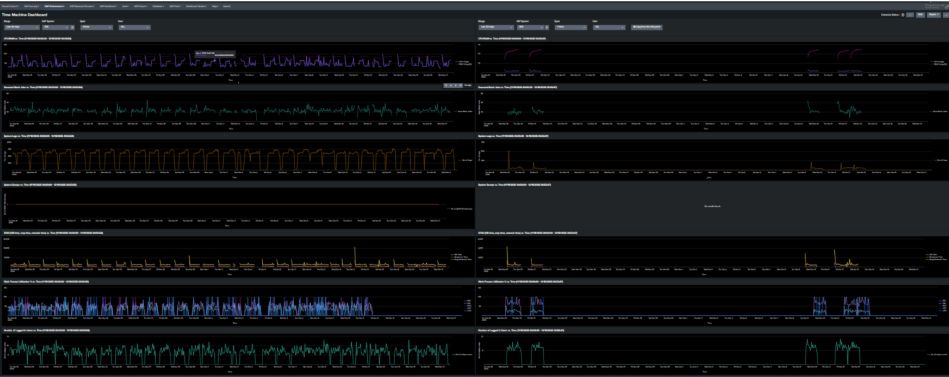
Time Machine Dashboard: System Readiness Comparison
PowerConnect’s Time Machine dashboards allow teams to rewind and replay system behavior across environments, providing objective insight during user acceptance load testing and migration preparation. Readiness is not declared in a meeting; it is proven in data.
This is how serious enterprises migrate to RISE with confidence.
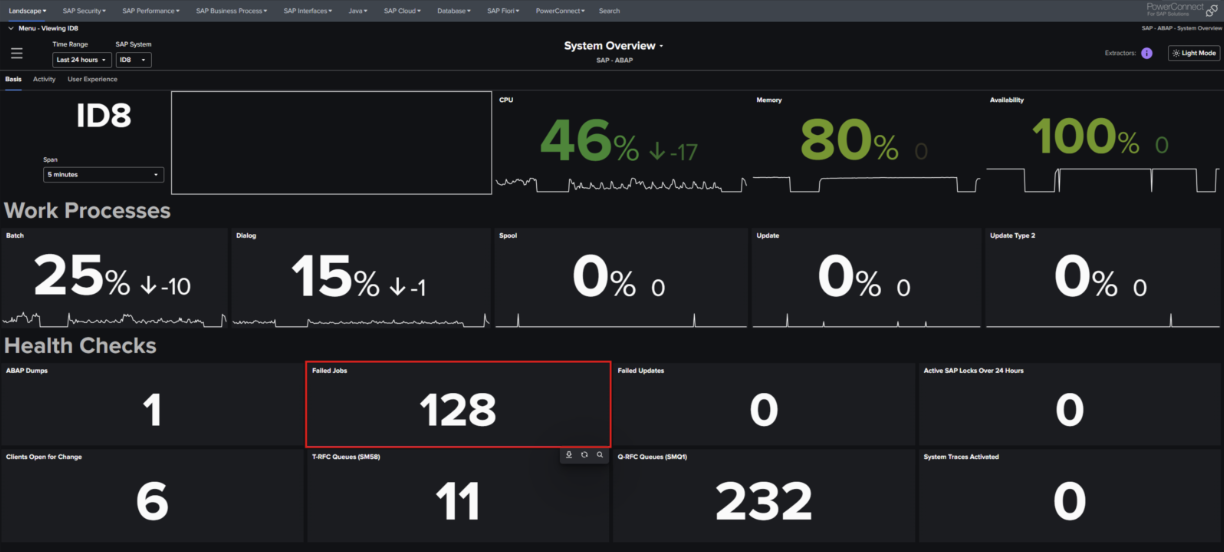
Landscape Dashboard: Basis Health
The PowerConnect Basis Overview Dashboard provides real-time visibility into critical system health metrics for Basis operators. By highlighting issues such as failed batch jobs and system anomalies, it enables technical teams to quickly identify root causes and minimize downtime, especially during cutover periods when even minutes of disruption can impact critical business processes and incur real costs.
Let’s talk - Request a Demo Here.